
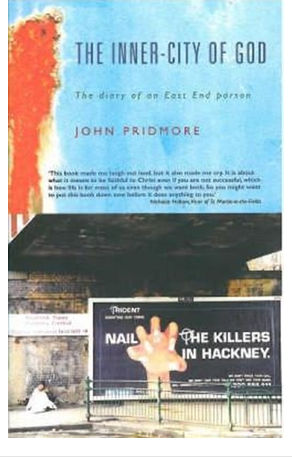
Twenty years ago John Pridmore retired from the Anglican ministry. He had served as a team rector and ultimately Rector of Hackney parish since 1995. He passed away on 29 September. His self-effacement belied a presence that towered up to his flowing white mane and beard, an accidental Moses descending apologetically with someone else’s tablets of stone.
I was churchwarden towards the end of his tenure and reviewed his memoir Inner City of God: The Diary of an East End Parson, just prior to its publication. My essay was too long and his successor only reluctantly cleared it for the church newsletter; but it’s a freeze-frame of a scrappy and troubled Hackney that was soon to be lost to gentrification. I am sure John sighed wearily at the irony and inevitability when the church, barely a decade after his retirement, succumbed to the Alpha empire. Remarkable to think now of the raggle-taggle of worshippers that once a week would make up the congregation in that cavernous space. So many of them have passed on now, busybodies from the Parochial Church Council, the old Irish verger, the cantankerous organist. The traditional oak pews were removed and sold off. You’d hardly recognise the place.
John’s funeral is on All Souls’ Day at St. Martin’s-in-the-Fields where he was assistant curate, perhaps his truer spiritual home.
….
In his last sermon as Rector of Hackney, the Rev Dr John Pridmore revisited a favourite bugbear. He was always troubled by the portraits of his predecessors, ranged austerely around him on the vestry wall: ‘Some of them are smiling,’ he said. ‘Some are frowning. Some are thinking about lunch.’ These former vicars and Rectors cut cold, assured figures. They represented for John the smugness of the Church of England establishment, and induced in him such grumpiness that he was adamant that after he retired he would never allow his own ¾ profile to be added to their exclusive gathering.
Inner City of God is John’s annotated diary from his time in Hackney. The steady prose, lucid and mischievous, is familiar to those of us acquainted with the weekly services he presided over and the columns he continues to write in the Church Times; the opening aphoristic sentence to intrigue the attention, the ironic, weary observations on prevailing currents in the Church and society. John relishes the absurdities of every day life and drops frequent (though at times a little predictable) lines of self-deprecation at every opportunity.
These memoirs are burdened with doubt. They begin with two fiery Hackney epigrams which for John seem to call into question the purpose of his vocation. In the first scene, the ever-present council skip besides the church has been set on fire, and a boy is avidly peeing onto the dancing flames: ‘Why do I suddenly wonder whether I’m doing any good?’ In the second, the conflagration is Gibbons department store opposite the Rectory. The emergency services were engaged in activity, the Salvation Army were handing out tea and rolls; everyone seemed to have their allotted function, except the ‘absurd vicar with his studiously composed expression of benevolence and distress…I wonder what I’m here for’. The same sentiment recurs when he pays a neighbourly but purposeless visit to the Hackney Mortuary. It’s not a surprise that ‘intractable’ should be one of John’s preferred adjectives; he applies it variously to the building, a stain on his suit jacket, and the Divinity of Christ.
What unifies this thin volume is a provocative and mischievous question: ‘What would we do in this situation if we assumed that Christianity were true.’ It is a profoundly unsettling question because it presumes that, despite our words and rituals, we don’t really believe what Christ had to say. In a sermon John had trotted out the well-worn trope of Christ being manifest in the hungry and homeless; ‘But supposing’ he wonders to himself after the service, ‘that Jesus then nicks your handbag.’ He confesses honestly to his refusal to expose his family to the risks which he personally had accepted in taking the job. He made the rectory and garden as impenetrable as possible. One night he, Pat and Becky pulled into the drive to find a homeless man by the garage. John wound down the window and asked him to go away. John sensed something imperfect about this state of affairs. But there is no answer; it’s just too uncomfortable to believe that Christianity is true.
Paradoxically, those who do espouse a Christianity of certainty are given pretty short shrift. He wants to set up a support group called Alphaphobics Anonymous ‘for those of us [who are] endemically melancholy and confused’. Alpha News’s ‘relentless chronicle of mounting success is little comfort to those of us whose more modest hope is to muddle through.’ At the fringes of faith, John is at his most insightful.
The oldest theological controversy of them all, the quarrel between Deuteronomy (‘Obey God, and you’ll never have it so good’) and Job (‘Obey God, and you’ll end up on a tip scrapping your boils with a broken flower pot’). Are we promised caviar or Calvary? Across the centuries the debate has swung to and fro. Now it seems that one side is finally winning.
What are we to make of a mega-church such as KICC just over the River Lea? It clearly ministers to a popular spiritual need. But listening to the preaching it’s hard to disagree with John’s evaluation of ‘exchange without dialogue – putty does not answer back.’ This must be an expression of Christianity – but for those of us tending to John’s theological bent – it is alien, distasteful. He confesses to being ashamed that he had not sought to build ecumenical bridges during his incumbency.
The diary gives us an inside view of John’s theology, and it’s a messy one hammered on the anvil of Hackney’s – here he cites the Hebrew term tohu-wa-bohu – primal chaos. The evangelical earnestness of his youth ‘thawed’ at Cambridge (‘The evangelicalism of Ridley in those days was temperate in its tone, civilised in its manners, and modest in its pretensions to scholarship.’) He readily, and rather casually, admits to his ‘Christian agnosticism’.
What matters are not religious truths or falsification, but religion’s inalienable role…
Perhaps, when the divine comedy is done, the words we’ll wake up to will be “I was only joking”.
He does not experience God as an ‘evident reality’, which made him unwilling to discriminate between the sheep and the goats. This was manifest for example in his controversial approach to signing off admissions to the two schools attached to St John’s. ‘Church schools, like churches themselves, should be for those outside.’ The requirement for new admissions is to attend church regularly. For John this could be and was satisfied by coming to church ‘at Christmas every other leap year’. Preferential treatment, and its attendant language of rights, he regards as heresy. One might argue that this was an appropriate stance to adopt in a borough of non-conformists. The irony is that John should have been the incumbent of a church that had been built by 18th century Tories as a stupendous riposte to the various radical dissenting movements around them.
I read recently that the communist poet Louis Aragon said he could think of nothing more beautiful than a church and some dynamite. Nothing depressed John more than the building – ‘A monument to establishment power and establishment arrogance’ – which in one of his more generous moods he thought less suited for worship than for indoor hand-gliding. When he recalls the surreal incident of an old man removing a large stone from the coping of the churchyard wall and throwing it at the church’s locked door, you wonder whether this senior vandal was the Rector himself – John probably wished it had been. He came to regard the church as a crude, hulking attack on the free-spiritedness of the borough. Its entrance faces away from the bustling heart of Hackney, the Narrow Way, as if the church had turned its back on the masses in pompous nonchalance. In its past hubris and present irrelevance, it is compared with ‘the broken trunk of Ozymandias in the desert’. George MacDonald’s 1867 novel Guild Court contrasts the ‘grey time-worn tower of the old church of Hackney’ with its replacement, ‘the ugliest building in Christendom, except the parish church of a certain little town in the north of Aberdeenshire.’ For John the church, as for MacDonald, represents God as ‘a high, haughty, cold, and forbidding deity’. John ignores however the alternative, equally compelling, reading of the space as a massive, inclusive refuge of tolerance; the neutral intersection of the postal areas E5, E8 and E9, which have become the calling cards of local gangs tagged onto the silent columns of the porches.
Instead, John rages. ‘The building was above all a cancer on my conscience. How could we justify preserving a building seating two thousand for a congregation of sixty or seventy?’ The evident bitterness stems from the false dawn of Hannah Roberts’s proposals in 2004 for a radical redevelopment which foundered when they reached the ‘risk-averse’ Diocesan Advisory Committee. Resolve to do something exciting was thus sapped, leaving behind the sense that the moment had been lost. As if to put a seal on the disappointment, a fire broke out when the electrics blew in January 2006, covering the place with a layer of soot and leaving us without light or heating in the middle of winter. It was the last straw and threatened to define John’s last year. And yet despite such adversity John drew comfort from the response of the congregation whose members, in normal circumstances, would sit at ‘intergalactic’ distances from one another, but who now seemed to be brought closer together – even if it was only for warmth. John is also upbeat about the restored churchyard, reflecting that ‘It’s good that Hackney parish church is set in a garden.’ Ultimately though, John’s critique of the fabric of St John’s is almost as subversive as Christ’s of the Temple. There is scant subtlety in his conclusion. ‘There is of course a solution to all these problems. But of that we may not speak’.
For all the diary’s railing and wailing, the only person whom John ever singles out for criticism is himself. He reserves his warmest words for the people he encounters, and particularly the stalwarts of the congregation. John’s quarry is not personal, it is the System – the ‘age of the planner’, in which utilitarianism is elevated over contemplation, and bricks and mortar over human beings. Clergy are expected now to be not so much ministers as managers of the local branches of a national chain store, with ‘delivery strategies’ and targets, except without the staff to order around. The church, as all other voluntary and public organisations, has appropriated the discourse of private business. Thoughtful believers, of whom John is a paragon, wrestle with this because there is a patent incongruity between a bureaucratic materialism of the market which pursues change for the sake of change, and a devotional religion which tries to understand and apply the simple, impossible teachings of a figure who lived 2000 years ago. ‘Jesus wasn’t much of a planner… the disciples after his departure… were just left to get on with it.’ John deplores what he sees to be a Church of England culture ‘intolerant of the idiosyncratic… the bland leading the bland,’ where clergy need to be more numerate than literate. True, but the established church has always by its very nature been bound up with the structures of power – if anything it is more willing than ever before to voice dissent against actions of governments and big business. Perhaps all that has changed is the language it uses. Nevertheless, the church must be a poorer place, if it can no longer boast characters such as Bishop Lash of Bombay, at whose hands John was ordained. Lash was renowned for his errant attention, and whenever he lost his place in a service he was conducting he would bid the congregation ‘Lift up your hearts’ to buy himself a few seconds to retrieve it.
Inner City of God is a Jeremiad, with no shortage of invective. He gave me a copy of the manuscript with the warning that should be read as ‘Old Testament’; the Rev Nicholas Holtam of St Martins in the Fields, where John had been before moving to Hackney, in his foreword compares it to one of the Books of Wisdom. As with most diaries, however, it is also an apologia. Behind John’s defiance is an attempt to justify his contemplative, often laissez-faire, approach to ministry.
I do not subscribe to the myth of progress and I am far from sure that in my eleven years in Hackney I got anywhere… All the most memorable and rewarding experiences of my life as an inner-city clergyman have been unplanned.
He was proud to say he belonged to a passing generation of clergy taught that mornings should be spent in your study. Books are always more important than meetings:
I am not ashamed that I sometimes chose to read and write rather than be out and about.
John pines after the days ‘when Anglican worship was so much more restful than it is now’. His first parish was in Cornwall, Britain’s remote and tranquil corner which remains his spiritual home. When I went to visit him in a very blustery Hove in December last year, John told me he is now more likely to worship with the local Quakers, where the pervasive silence of their meetings is punctuated only rarely, if at all, by the odd reflection of its members. He objects to the obsession with constantly doing things when people (quoting MacDonald again) ‘just want to be to be left alone to look after the cattle.’ The church should aspire to do no more than John the Baptist, which was to point at Jesus, and then get out of the way.
In that the church is surely successful. John, as we all did, brought with him every Sunday the burden of the tragi-comedy of life in Hackney – the Tesco bag of pirate DVDs lobbed over the wall in the rectory garden, the deafening Saturday morning harangues of gospel zealots outside Marks and Spencers, periodic pangs of moral and vocational ineptitude. We all laid it on the altar where it was at once sanctified and consumed.
All the little sadnesses, absurdities, and follies that have preoccupied me over the last twenty-four hours have been brought to the Holy Table and dealt with. These irritations are far less important than the delightful people I say good-bye to at the door. No doubt next Sunday there will be other tribulations… Meanwhile I tell myself, as I stroll home for lunch, that this is a good place to be.
The Church of England is eloquently compared to King Lear, ‘still secretly in love with the rococo trappings of power it no longer holds, a church that may yet be forced to exchange its strongholds for the wilderness and to find its true identity beneath the bare branches of the cross.’ Its decline brings it closer to its origins, despised and rejected by all. This is the curious note of optimism with which John concludes.
John has indeed joined the assembly of his predecessors on the vestry wall. He is not posing sombrely in his priestly vesture, but sitting in a comfortable pullover laughing at the camera with his cat in his lap.
April 2008.


Leave a Reply