
“… unto the Jews a stumblingblock, and unto the Greeks foolishness.” 1 Corinthians 1:23
‘You can’t remember whether life is shit because Arsenal is shit, or if it’s the other way around.’ Nick Hornby, Fever Pitch
We each forge our own hybrid identities which often make little sense to either ourselves or to others. Witness the scenes in North London last Monday when with a whimper Arsenal became champions after 22 years of dashed hopes and insanity. They didn’t kick a ball but the title became mathematically theirs thanks to a doughty AFC Bournemouth who managed to thwart Manchester City, English football’s nearest equivalent to the Death Star. The fans have invented a new anthem ‘North London forever’ in recent years, yet another object to stick in the craw of Sp*rs who had been long established in the area before ‘Woolwich Arsenal’ moved to Highbury and then by sheer chicanery got promoted to Division One at their new neighbours expense in 1915. The colonisation and appropriation of the N postcode district is now complete.
Having been in exile for almost as long as Arsenal’s premiership trophy drought those images gave me major fomo. Memories remain vivid from the early 2000s of heady sunny afternoons merging into beer-soaked evenings of cheap lager and john smiths and guinness splashing from of 1000s of plastic pint pots in the pubs at Finsbury Park, watching wide boys standing on wooden benches outside the Twelve Pins (i.e. Twelve Bens – the mountain range in Connemara – a nod to the area’s – and the club’s – deep Irish connections), bawling out ribald songs like this one to the tune of the Addams Family:
Gary Neville’s mother
‘s exactly like his brother
They look like one another
The Neville Family
Your mother is your sister,
Your father is your brother,
You all shag one another,
The Neville Family
The last time Arsenal won the league we were wedged in on a Sunday in late April 2004 among the surge of sweatybeery bodies to watch Chelsea lose to Newcastle in the lunchtime kickoff which meant Arsenal only needed a draw in the North London derby away to Sp*rs later that afternoon. Half the pub emptied when those with tickets exited singing (tune: ‘I came I saw I conga’d’) ‘Let’s go down the shithole, lets go down the shithole… ’), so ever since we could claim we won the league at White Hart Lane. Another humiliation for the team that wears a cock on its shirts.
Neutrals hate Arsenal and there are now Guardian articles about why that might be. They represent the entitled, ethereal, self-righteous, politically-acceptable cultural apparatus which is now branded wokeism and all the right-on celebrities emerge from the woodwork when Arsenal win – Starmer, Corbyn, Cumberbatch, and now sundry Americans like Anne Hathaway, Spike Lee and Mayor Mamdani. In Fever Pitch, Nick Hornby wrote you could easily get a cheap place near Arsenal stadium because no one wanted to live near a football stadium. That was in the late 80s. When I sought out a home in the area barely a decade later the closest I could afford was Hackney, itself now long since been gentrified beyond recognition. (I remember the first appearance of a retro Edwardian beard in the Pembury Tavern which had only recently been relaunched in proto-hipster-guise.)
Arsenal, whose sorrows have tracked almost precisely the social media era, have become the meme generators of football bantz, and finally last week bucked the bottler reputation, a barb which was swiftly replaced by conspiracy theories of refereeing collusion to ensure they won the league. English football has never been more dominant but it’s been a poisoned well ever since Abramovitch pumped his ill-gotten billions into Chelsea (in 2004 – Arsenal never won the league again, until now) and then the UAE did the same with Man City in 2009. The mainstream can vent its selective moral outrage at an intern at Southampton for filming rival teams in training, but they self-gag when it comes to the 115 charges against City for financial irregularities which should (if there is any justice in the game) but won’t (because there isn’t), if proven, result in them being stripped of all the trophies they have swept up since they became a slush fund for an authoritarian state infinitely rich on the back of fossil fuels and systematic human rights abuse. God spare us the gushing tributes to the genius of Pep.
Along Holloway Road and environs last week the streets were flooded as pent up frustrations erupted, a defiant resurgence like it felt in 1989, because my other team, the one I should probably support more because of where i grew up, Crystal Palace, are also lifting prestigious silverware for the first time in their history.
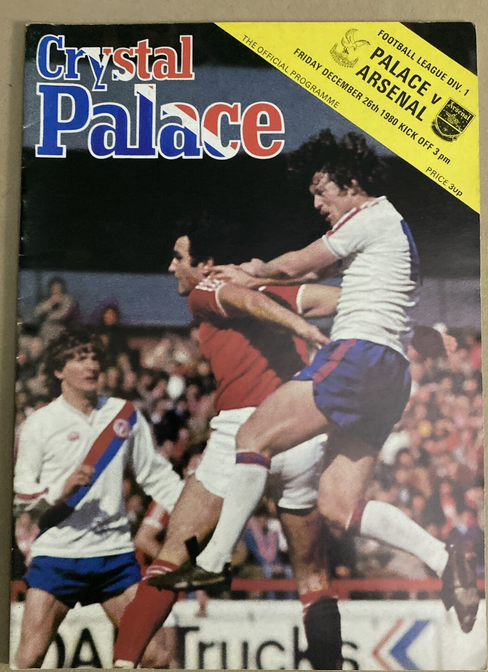
Palace and Arsenal represent two sides of the London identity, south and north, earthy and aesthetic, rough and refined, apolitical and political, banter and bitter sarcasm, small and big, poor and rich. The first game dad took me to was Palace-Arsenal in December 1980. That was the season Palace got relegated. In 1989, my father got season tickets in the ‘Panini Family Enclosure’ a supposed smoke-free, yob-free safe space (these were the post-Heysel years) in the East Lower stand – but it was not swear-free space and dad was shocked at the anglosaxon effing and and see-you-next-Tuesdays being sprayed liberally at linesmen, the away end, our own underperformers (remembering the sadness of Gus Caesar), and Vinny Jones. So pretty much every other Saturday it was dad and me and my best mate Stephen setting off for East Croydon and the mystery which was London. Steve started the season a Liverpool fan because after all it was the 1980s and we had come to blows so many times over the years because football on and off the pitch was the primary source of our rivalry: he was by far the better player, and he supported by far the better team. We were 15 and my dad turned 50 on the day we sat watching Arsenal labour to a 1-1 draw with Sheffield Wednesday.
Last time Arsenal won the league dad had been in the stands at White Hart Lane (again!) in 1971 but it had not happened in my lifetime. In 1989 we were getting so close, and then Hillsborough happened and out of that appalling and unnecessary tragedy and emblem of Thatcher’s disdain for the northern working class, Liverpool were suddenly resurgent and Arsenal faltering. So when the three of us gathered in our front room in South Croydon in front of the telly on 26 May 1989 we had faint hopes of Arsenal winning by two goals at Anfield where Liverpool had not lost all season. Then when Michael Thomas ‘charging through the midfield’ dinked over Bruce Grobelaar for the last minute second goal the feeling was beyond anything I have experienced before or since. (Nick Hornby tries to find a worthy comparison, but in the end decided that even orgasms and the birth of your child fall short – because with 26 May 1989 you didn’t know if was going to happen.)
Only a week later I was with a group of boys from my school – all Palace fans – and we went to Selhurst Park to see the second leg of the Second Division play-off final. We were in the stand referred to as the ‘Sainsbury’s End’ because it backed onto the supermarket. Palace who had a goalkeeper called Perry Suckling, overturned Blackburn Rovers’s 3-1 advantage with Ian Wright – again in the dying minutes of extra time – getting the tie-winning goal and the stadium erupted with ‘Glad All Over’ thumping across the terraces and into the streets surrounding. Palace thus returned to the First Division again after being relegated that season dad took me to my first game. The ensuring summer was long and hot there was Billy Graham converting the gullible at the Crystal Palace Stadium (the one for athletics, not football) and I discovered James Brown and Motown and all of sudden for the first time in my life I saw the rich possibilities of life in a world that my hitherto ultra-religious childhood had smothered and blinded me to. A teenage epiphany and awakening whose catalyst was football, and precisely, Arsenal and Palace. Pal-Arse.
When I saw Palace win the Conference League this week and the ecstasy of their fans in Leipzig I felt somehow more affinity for those normal looking men and women from Norwood and Streatham and Beckenham who speak like me in my unguarded moments when I am not putting on airs… more affinity than for Gooners towards whom, a bit like Hornby – who is even less a Londoner – I decided to gravitate and construct an ersatz identity however grounded it was in a genuine bond passed down to me by my father whose first home as an immigrant in England was just off Highbury Corner.
This is the interior monologue in my saccharine nostalgia which makes 1989 to me what 1971 was to him. The obsession makes little sense to the initiated but like J Alfred Prufrock I have measured out my life with such trivia. In 2026 Arsenal have won the league again and Palace have a European trophy and tonight Arsenal probably won’t, but just might, win the Champions League against another oil-state sportwashing plaything – Paris Saint Germain. I will watch it with dad.


 ofthewedge
Leave a comment